
Autonomous North
Geopolitics, AI, and Climate
In the 1990s, the Arctic was widely framed as an exception to global geopolitics: a zone of peace, disarmament, and pragmatic cooperation. This idea of Arctic exceptionalism took hold in policy and academic circles alike. Yet climate change and renewed great-power competition have steadily eroded that narrative. What was once protected by ice, distance, and inhospitable conditions is now increasingly accessible and contested.
The Arctic is warming roughly four times faster than the rest of the world. As glaciers retreat and permafrost thaws, new shipping routes and natural resources, including critical minerals, are becoming reachable. For now, Arctic shipping lanes are accessible only during the summer months and still costly to navigate. But scientists estimate that the Arctic Ocean could be largely ice-free by 2040. As navigation becomes feasible for longer periods each year, as much as 5% of global shipping could eventually be diverted northward.
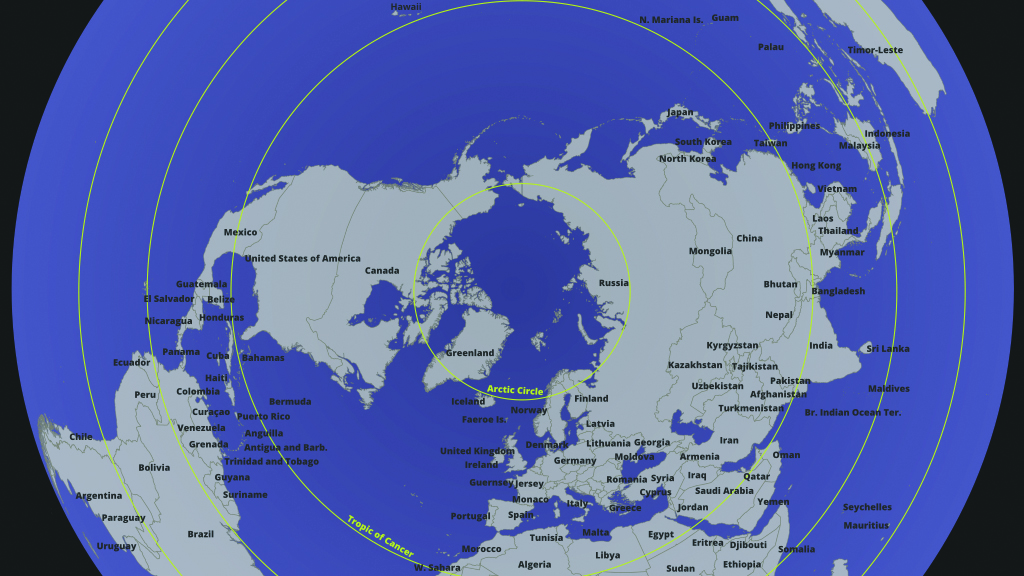
This transformation has direct implications for Canada. Forty per cent of Canada’s territory lies in the Arctic, making it central to the country’s security, economy, and environmental stewardship. While geography once insulated the region, climate change is dissolving that buffer. At the same time, emerging technologies underpinned by artificial intelligence (AI) are becoming critical to how states monitor, manage, and compete in the North.
Why the Arctic Matters for Canada
The strategic importance of the Arctic is now explicitly reflected in Canadian policy. Canada’s 2024 defence policy, Our North, Strong and Free: A Renewed Vision for Canada’s Defence places the region at the centre of national security planning. Concerns are becoming realities as American President Donald Trump threatens Greenland’s sovereignty and states that stand with it. Although Trump has rolled back proposed tariffs, world leaders have taken note of the United States’ apparent disregard for the rules-based international order.
The environmental shifts in the Arctic have positioned the region at the intersection of geopolitical competition and technological innovation. For Canada, the primary challenge lies in developing a framework for engagement that balances national security with environmental stewardship.
Canadian Prime Minister Mark Carney took notice of the decline at the January 2026 meeting of the World Economic Forum, acknowledging the emergence of a “new world order.” Rather than treating China solely as an adversary, Carney and Chinese President Xi Jinping reportedly found common ground when discussing Greenland and the Arctic. This shift reflects what is being described as a ‘new pragmatism’ for Canadian foreign policy with implications for Canada’s role within an evolving geopolitical and technological order.
Introducing AI to the Arctic
This recalibration of Canadian foreign policy sets the stage for a closer examination of how emerging technologies, particularly artificial intelligence, are contributing to Arctic governance and security. AI is a foundational technology for modern economies, green transitions, and military operations. The Canadian Armed Forces and the Department of National Defence have committed to integrating AI across their operational capabilities, including maritime awareness and surveillance. The Royal Canadian Navy is currently trialing AI-enabled systems to enhance situational awareness in northern waters.
Yet AI’s significance in the Arctic extends beyond defence. As a dual-use technology, it offers tools for environmental monitoring, climate prediction, sustainable resource management, and human security. In a region where physical presence is costly and often dangerous, AI-enabled remote sensing offers the promise of a means to “see” the Arctic continuously and at scale.
Capitalizing on Dual-Use AI
Private and community-driven initiatives demonstrate some of this potential. In 2021, PolArctic piloted software that blends Indigenous knowledge, scientific data, and remote-sensing techniques to identify previously undiscovered fishing locations. The system supports sustainable fisheries management while also improving navigation through sea ice, an example of how local knowledge and advanced technology can reinforce one another.
Such capabilities are of growing interest to militaries worldwide. The United Kingdom, for instance, has invested £544,000 in a project by the Alan Turing Institute to enhance Arctic detection capabilities. PolArctic’s “digital twin” model creates virtual representations of physical environments offering insights not only for defence but also for shipping, environmental protection, and infrastructure planning.
Traditional approaches to domain awareness rely heavily on sustained human presence, which is uniquely challenging in the Arctic. Polar night, extreme weather, and vast distances limit patrols and surveillance. Canada’s North Warning System currently consists of just 46 active radar sites across the entire northern region. Recognizing these constraints, Canada has committed $38.6 billion over the next two decades to modernize NORAD.
Expanding remote sensors and integrating them with AI could enhance defence capabilities while simultaneously advancing climate science. Doing so would allow Canada to establish comprehensive environmental baselines—something that does not yet exist for much of the Arctic. Without such baselines, it is difficult to measure or respond effectively to environmental change.
With better data, AI systems can also model impacts on wildlife and communities. As sea ice melts, migration patterns shift and encounters between humans and wildlife become more frequent. In Nunavut, AI-enabled radar systems now warn communities of nearby polar bears. Originally developed for military use, these systems automatically notify residents and can trigger non-lethal deterrents, such as lights or noise, to prevent dangerous encounters.
Environmental Costs and Trade-offs
Still, AI is no environmental panacea. Data centres consume vast quantities of water for cooling, while the chips that power AI systems depend on critical minerals often sourced from environmentally sensitive regions. AI’s energy demands are also growing rapidly. In 2025, AI usage emitted roughly the same amount of carbon dioxide as New York City.
In the Arctic, this creates a vicious cycle. Rising global emissions accelerate warming, opening new shipping routes. Increased shipping then produces additional emissions—carbon dioxide, nitrous oxide, and sulfur oxides—that further degrade the environment. These gases contribute not only to warming but also to ocean acidification and declining oxygen levels, reducing the ocean’s capacity to regulate the climate.
Strategic Outlook and Policy Priorities
The environmental shifts in the Arctic have positioned the region at the intersection of geopolitical competition and technological innovation. For Canada, the primary challenge lies in developing a framework for engagement that balances national security with environmental stewardship. While AI-enabled systems offer significant potential to enhance regional safety and resilience, their deployment must be guided by clear ethical and operational standards.
At the heart of Arctic exceptionalism was cooperation. Restoring a measure of that exceptionality will require deliberate policy choices. For example, Canada should work collaboratively through the Arctic Council to establish a comprehensive environmental baseline. By leveraging its long-standing leadership experience on the Council, Canada can foster the technical cooperation necessary to monitor climate impacts accurately and focus on shared scientific inquiry.
The Arctic is no longer insulated from global pressures. But with prudent governance, cooperative frameworks, and careful use of AI, Canada can help ensure that the High North remains a model for responsible adaptation and regional stability in an evolving world. Ultimately, the Arctic serves as the definitive testing ground for Canada’s ‘principled pragmatism’—a region where the nation must reconcile intensifying global competition with the stark realities of geography while proactively asserting its sovereign interests.
Kianna Low-A-Chee was a Research Intern at Project Ploughshares through the Technology Governance Initiative at the Balsillie School of International Affairs, with support from Mitacs. This article is part of a research project supported by funding from the Mobilizing Insights in Defence and Security (MINDS) program of the Canadian Department of National Defence, examining Canada’s role as a middle power in a shifting geopolitical and technological order.
Published in The Ploughshares Monitor Spring 2026