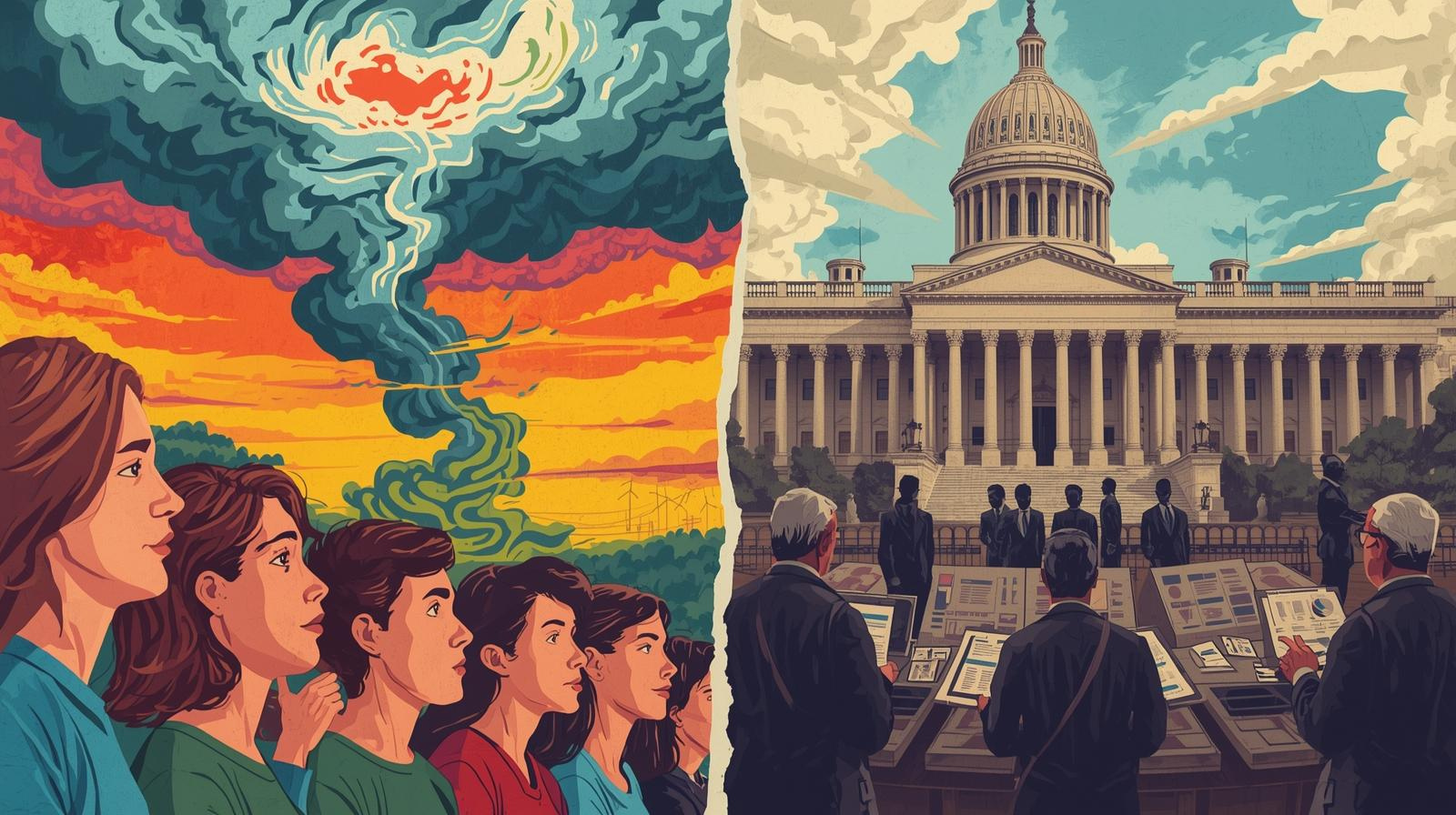
The Great Climate Disconnect
While young people see climate change as the real security crisis, their governments still don’t.
In 2019, Greta Thunberg addressed the United Nations and became the face of youth climate action. For her generation, coming of age during a time of once-in-a-century floods, monthlong wildfires, and creeping drought, climate security is vital to their own security and prosperity. Today’s youth, who are definitely experiencing high levels of climate anxiety, are now speaking out.
At the same time, governments are reneging on climate commitments, continuing to prioritize traditional security threats over climate challenges. They appear to be paying more attention to fossil-fuel lobbyists that dominate the public arena by spreading disinformation. The result is a widening gulf between leaders and youth and the ways in which each experiences the world.
Government Inaction
COP30, held in Belém, Brazil this past November, epitomized this schism. Despite being hosted in the Amazon–one of the world’s most fragile and vital ecosystems–the summit ducked some basic tasks. Fragmentation, protectionism, and great-power rivalry again worked to prevent the creation of the deep cooperation required to avert escalating climate shocks. Fossil fuels were not mentioned, even once, in the final outcome document, nor were any binding commitments made to protect forests.
And the international community is not the only one struggling to meet the challenges of climate change; national governments are also falling short in recognizing the security implications. A recent study analysed 94 public safety and national security documents to assess levels of commitment to solving the climate crisis. The results are bleak.
Although 81 countries mentioned climate change in national security documents, most references were “insubstantial, and some are even evasive and disingenuous.” Canada’s 2017 national security document Strong, Secure, Engaged devoted less than three percent of the text to climate change. Belgium, the Maldives, Denmark, Samoa, and the United States dedicated the most content to climate change, but none exceeded 21 percent. Despite the urgency of the situation, efforts appear to be stalling around the world, with few exceptions.
This also contrasts sharply with the reality that requests for Canadian Armed Forces assistance in natural disasters and emergencies, including wildfires and floods, have doubled every five years since 2010.
Youth Speak Out in Canada and Abroad
Statistics Canada identified climate change as a top-five issue for Canadian youth, with 62 percent agreeing that Canada has an obligation to lead climate initiatives. Another study found that 64 percent of people aged 16 to 25 believe that the Canadian government is not doing enough to avoid a climate catastrophe. When the federal government does act, its response is perceived negatively, with a significant percentage of the participants surveyed feeling betrayed rather than reassured.
Canadian courts continue to ignore youth demanding justice on climate issues. In the 2019 case La Rose v. Her Majesty the Queen, 15 youth argued that Canada’s action–or inaction–was threatening their rights under the Charter of Rights and Freedoms. In 2023, the court ruled against the claimants because of “an overly broad and unquantifiable number of actions and inactions on the part of the Defendants.”
Youth around the world are also taking legal action to call out big polluters and governments for harming the planet. In Japan, 16 people are suing 10 thermal power companies in an attempt to make them reduce carbon emissions and decarbonize by 2030. In 2015, 21 Americans first brought a lawsuit against the federal government for violating the rights of younger generations to life, liberty, and property; and for failing to protect essential public trust resources such as water. Since then, courts have systemically silenced these individuals.
Why Are Governments Failing Younger Generations?
The 2025 Canadian federal budget remains focused on traditional security. According to Caroline Brouillette, executive director of Climate Action Network Canada, “this budget shows that ‘austerity’ applies to efforts to protect people and the planet–but that more money can always be found for military spending and polluting industries.” Why is our government–and others around the world–taking such a stand?
Polluting industries, especially fossil fuels, have deep pockets and connections that gain them access to those who set government policy. At COP30, 1,600 fossil-fuel lobbyists were present – 12 percent more than at COP29. Such a large presence impacts the ability of states to cooperate and act as a collective. These lobbyists spread climate misinformation and disinformation to create the illusion that fewer people support climate action than is actually the case.
Professor Matto Mildenberger of the University of California Santa Barbara, who specializes in environmental politics, and Harvard professor Dustin Tingley, who focuses on the political economy of climate change and energy transitions, found in both China and the United States a significant perception gap between the public and elite. In effect, elites drastically underestimate public support for climate action. However, according to a 2022 study, between 80 and 90 percent of individuals in general make the same mistake.
A Path Forward
Governments are developing defence policies that require the allocation of more funds to purchase military equipment, which causes significant harm to the environment and climate. Meanwhile, climate action makes little headway on political agendas. COP30 failed to address two of the most pressing factors that impact climate change: the continuing use of fossil fuels and deforestation, but not because of a lack of public concern.
The problem is not public apathy. Upcoming generations clearly do understand the dangers of climate change and want government action. What is needed now is to have the public will drive government policy. Governments around the world should:
- Make climate change a core national security issue.
Governments should integrate the risks associated with climate change into defence and security strategies, threat assessments, and budget planning. - Curb the power of lobbyists for fossil-fuel industries.
Mandatory transparency rules, public disclosures of lobbying activities, and cooling-off periods for government officials that move into the fossil-fuel sector would help prevent industry influence from shaping government policy on climate interventions. - Give youth a formal voice in climate-security policy.
The participation of youth climate councils, if given the ability to provide input to cabinets and foreign policy agencies, would allow both youth and government to come to a clear understanding of the other’s views and would encourage the embedding of youth-oriented views in the development of official policy.
Taken together, these steps would begin to align political priorities with the world that upcoming generations face, in which climate shocks increasingly determine the state of human security.