Why Civil Society Still Matters in Disarmament
Kianna Low-A-Chee is a Balsillie School Research Fellow at Project Ploughshares.
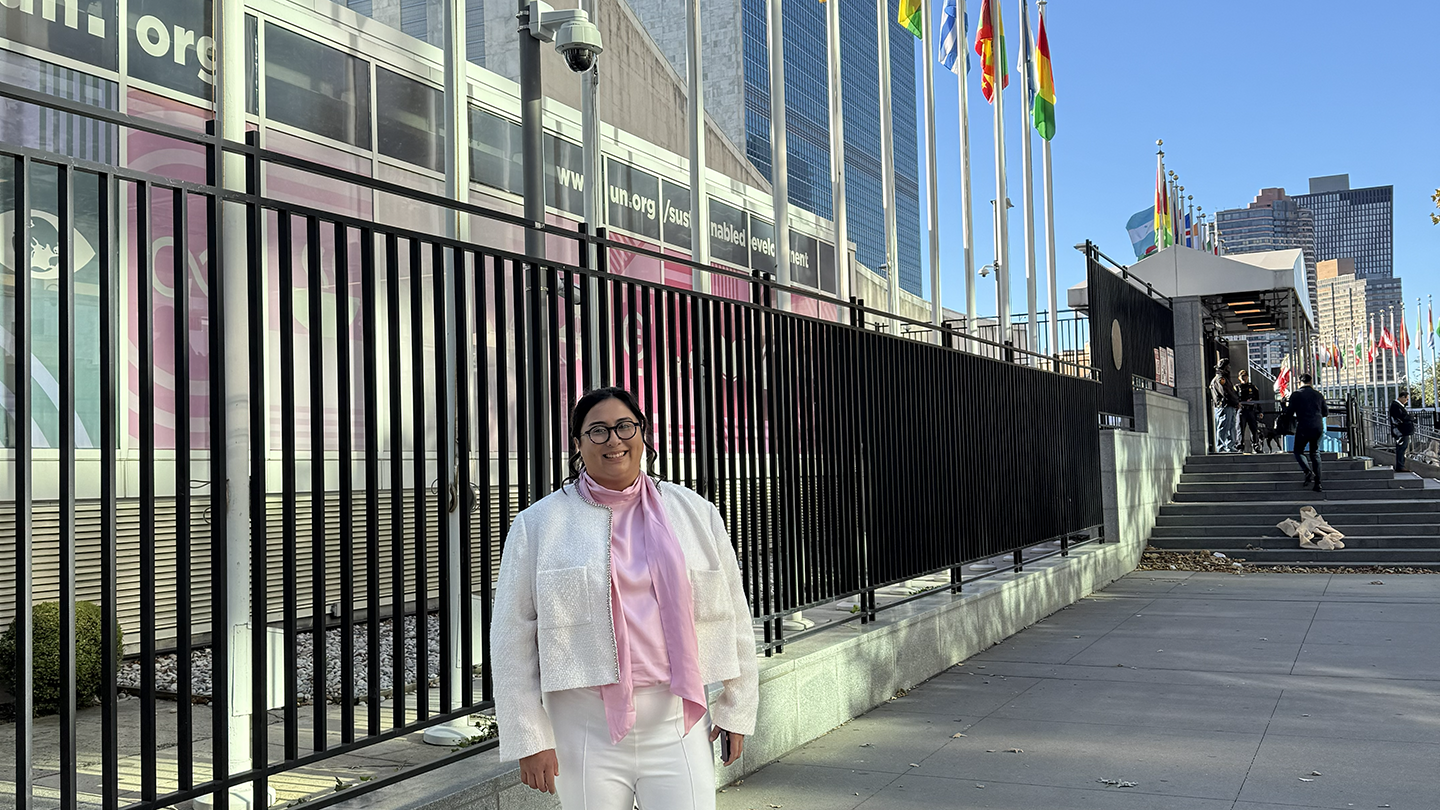
Each October, Member States of the United Nations gather in New York to attend the First Committee on Disarmament and International Security, and participate in speeches and procedural skirmishes, and, occasionally, to determine matters of substance. On the final day of this year’s session, the eightieth in the history of the UN, civil society – academics, campaigners, and representatives of civil society organizations (CSOs) – took to the floor to remind member states of what is at stake. I was honoured to deliver the statement on outer space security, on behalf of Project Ploughshares and 16 CSOs.
Even securing this and other opportunities to engage has become contentious. Several member states question or seek to curtail civil society’s participation in arms-control debates. But civil society’s voice remains one of the few that can still cut through the diplomatic routine. Calls for trust and cooperation dominated the morning’s proceedings. By afternoon, after civil society had spoken, the mood had shifted. When the CSO, the Conflict and Environment Observatory, referred to Israel’s “genocide in Gaza,” only Israel objected, albeit strongly. The Israeli delegate’s indignation underlined another enduring truth: the purpose of civil society is not to comfort the powerful, but to confront them.
The fraught reality in which arms control and disarmament discussions take place today requires an engaged, active civil society. As the International Committee of the Red Cross noted, “over 130 conflicts are raging today, twice as many as 15 years ago.” Today’s conflicts, which are more complex and prolonged, have a devastating impact on civilians. CSOs give those most at risk a voice.
CSOs delivering democracy
Civil society contributes to multilateralism by adding diverse voices to discussions, helping to shape debates, influence the language used in resolutions, and inspire more effective resolutions. In this way, civil society helps to legitimize global governance by representing some of the multitude of opinions held by some of the world’s citizens.
In an age of increasing militarization, civil society plays a vital role in multilateralism. Norms and treaties are not formed overnight; both require sustained attention and effort which civil society offers.
This diversity of perspectives reflects the broader reality of international politics, which is far from monolithic. The international community is made up of a “rich tapestry of competing social and political discourses.” Without civil society, only official member state perspectives would be heard, with the most powerful states likely dominating discussions. These views tend to prioritize the security of the state over human security. Often this desire for security is expressed in spending on the military. In 2024, global military spending surpassed $2.7 trillion USD. Civil society speaks for all the world’s citizens who need secure access to food, housing, and education. And we are not screaming into the void; when we speak in international forums today, more and more states are listening to us.
In an age of increasing militarization, civil society plays a vital role in multilateralism. Norms and treaties are not formed overnight; both require sustained attention and effort which civil society offers. The success of the Mine Ban Treaty and Convention on Cluster Munitions reminds us of the importance of civil society and these organizations’ perseverance. Despite the wide use of anti-personnel landmines and cluster munitions, civil society was able to campaign against the two technologies by appealing to humanitarian consequences and International Humanitarian Law. Civil society empowered like-minded states to engage in negotiations of the treaties rather than efforts being stopped by the need for consensus.
Sustained Efforts in Disarmament
Long term interest and consistency in messaging creates a pressure that states cannot avoid. Through accountability and the creation of moral and political pressure, states are likely to align behaviour with the norms being advocated for.
Civil society offers sustained attention to topics through monitoring, expertise, and campaigns making civil society a key part of the information eco system. States are concerned with a variety of issues; we concentrate on specific topics and maintain longer-term interest in disarmament. By sharing knowledge with states through monitoring and public engagement, well informed decisions can be made.
As representatives rotate out, civil society maintains its presence allowing for a continuity of efforts rather than starting over each time a new delegate enters the scene. This allows for more efficient governance as CSOs can inform discussions and debates using experience and expertise to shape debates and resolution language. Equally important, they help ensure that humanitarian concerns are not lost amid political or technical discussions.
The need for reminders of impacts on civilians is great. In 2023, civilian casualties reached record highs not seen in decades; with the current pace of technological innovation with the potential for military applications, communication and expertise offered by CSOs are needed to prevent an arms race.
Fostering Cooperation
The bedrock of multilateralism and disarmament is cooperation and trust. Both Libya and Colombia reminded us of this at the First Committee meeting, respectively offering messages of peace by consolidating trust and not amassing weapons, and of security through cooperation, not force. The Maldives noted the importance of renewing cooperation and working as a collective for greater security, stating “disarmament is not a choice; it is a responsibility. We must restore trust, renew dialogue, and redirect resources from weapons to development.” Yet, building and sustaining this trust often requires dialogue that extends beyond states themselves.
In cases where states are at odds, CSOs act as a communication bridge between parties creating space for neutral dialogue. When official channels cannot be accessed, CSOs are able to connect states, advocacy groups, humanitarian organizations, and disarmament experts in informal settings. Workshops and conferences can offer a space for neutral dialogue and foster cooperation by reducing the mistrust that can arise in more formal discussions. These spaces allow states to come together and find common ground.
CSOs not only foster dialogue by convening meetings – we come prepared with facts. The transparency of facts is vital in an age of disinformation and misinformation. By presenting actors with verified reports from experts regarding impacts and risks associated with weapons, trust is built. Offering consistent and reliable information rather than augmented facts that support specific interests builds the confidence of states that we are providing the whole picture and can be reliable partners in the moment and in future scenarios. As King’s College London has emphasized, “strengthening information integrity should become an integral element of our collective efforts to uphold and advance the disarmament regime. By defending truth, we defend trust—and trust remains the foundation of disarmament and international security.” In this way, the work of CSOs reinforces the very principles that sustain effective multilateralism: truth, trust, and transparency.
Civil Society Still Matters
While the “golden age” of civil society may appear to be over as civic spaces shrink, CSOs face politicization, and funding is shrinking; our work still matters. When states do not abide by norms or international law, civil society will be there to hold the state accountable. We will prioritize a multi-perspectival approach to global governance to add democratic legitimacy to global governance. Effort will be sustained as governments rotate, creating consistency and contributing expertise to discussions. Cooperation will remain a priority for CSOs as the issues facing society today cannot be tackled alone, disarmament cannot be achieved by one state alone; it requires global trust and restraint. Sustaining this work depends on a broader community that values dialogue, evidence, and the quiet persistence needed to keep peace efforts moving forward.
Published in The Ploughshares Monitor Winter 2025